

Product
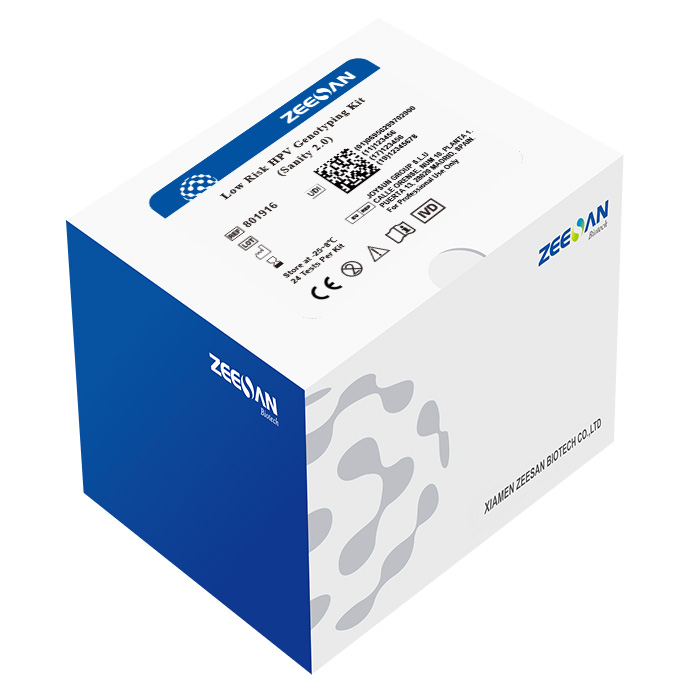
Low Risk HPV Genotyping Kit (Sanity 2.0)
The Low Risk HPV Genotyping Kit (Abbreviation: Sanity 2.0 L-HPV) is a qualitative in vitro test used for HPV genotyping and cervical cancer screening using cervical cells collected by swab, TCT or LCT. This test utilizes Polymerase Chain Reaction (PCR) for DNA amplification and nucleic acid hybridization for the detection of HPV types in a fully automatic instrument (all-in-one machine). This test specifically identifies 14 low-risk HPV types, including HPV-11, HPV-6, HPV-53, HPV-26, HPV-42, HPV-69, HPV-81, HPV-43, HPV-40, HPV-72, HPV-44, HPV-61, HPV-54 and HPV-70.
The test is indicated to use with cervical cytology to adjunctively screen to assess the presence of low risk HPV types in women age 30 and older, considering other risk factors such as cytology history to guide patient management.
The Sanity 2.0 L-HPV is intended for use by trained clinical laboratory personnel specifically instructed and trained in the techniques of real-time PCR and in vitro diagnostic procedures.
Principle
The Sanity 2.0 L-HPV is based on the technology of multi-color melting curve analysis (MMCA). HPV genotypes are identified by the different Tm values of hybridizing PCR products with the fluorescent probes. Several HPV type-specific probes are designed with the same fluorophore and quencher that will be detected in one single channel. It was designed that the Tm value of each probe-target hybrid differs with varied length and G/C content of the probe. At the same time, human glyceraldehyde-3-phosphate dehydrogenase (GAPDH) gene can be detected for quality control of sample collection, extraction and amplification as an internal control (IC). For ease of storage and transportation, the amplification reagent is designed in pre-distributed dry form.
CE-IVD Marked
Interested to Know More about Our Solution to Molecular Diagnostics?